
If you are searching for a destination management company in Spain, you are probably organising a corporate event, incentive trip, or conference somewhere you do not know from the inside. That is exactly the gap a DMC exists to close. This guide is for event managers, HR leads, and executive assistants who need practical answers. What does a destination management company in Spain actually do? How is the market structured region by region? What separates a properly accredited DMC from a generic local supplier? We cover services, regional coverage, accreditation to check before you sign, and what working with a DMC looks like from first enquiry to final invoice.
What Is a Destination Management Company in Spain?
A destination management company, or DMC, is a locally based partner. It plans and delivers events on your behalf in a country or region it knows firsthand. In Spain specifically, that means a company with staff, supplier contracts, and market knowledge inside Spain itself. It is not a partner working the country remotely through subcontractors it has never met in person.
If you want the full picture of what a DMC does and why the model exists at all, our explainer on what a DMC does for corporate events covers that in detail. This guide takes a narrower angle: what defines a destination management company operating specifically in Spain, and how to judge whether one is right for your event.
What a Destination Management Company in Spain Delivers
The exact scope varies by client and event type. A full-service DMC in Spain typically covers the following ground.
Venue sourcing and contract negotiation. Matching the brief to the right venue and region. Then negotiating rates that reflect group size and season, rather than accepting the first quote.
Hotel blocks and room allocation. Negotiated directly with properties rather than through a booking platform. That matters once you need to hold or release rooms close to the date.
Private ground transport. Timed around your programme for the whole group.
Bilingual onsite staff. Present throughout the event. Able to resolve a supplier issue in Spanish before it ever reaches your desk.
Activity and experience design. Suited to the group’s profile, from a formal gala dinner to a team building programme layered into a wider corporate event.
Local regulatory knowledge. Noise ordinances, event permits, and other rules that differ from one region of Spain to the next.
Our own DMC Spain and Portugal page sets out our full service scope. Our guide to corporate event management in Spain goes deeper into how that scope translates into a working process once you have a partner in place.
Destination Management Company Coverage Across Spain’s Regions
Spain is not a single, uniform market. Venue supply, permitting, and typical lead times shift from one region to the next. A DMC does not need an office in every city to manage this well. What matters is supplier relationships and hands-on experience in each region, backed by one team that coordinates the whole country rather than a patchwork of local subcontractors.
Catalonia and Barcelona
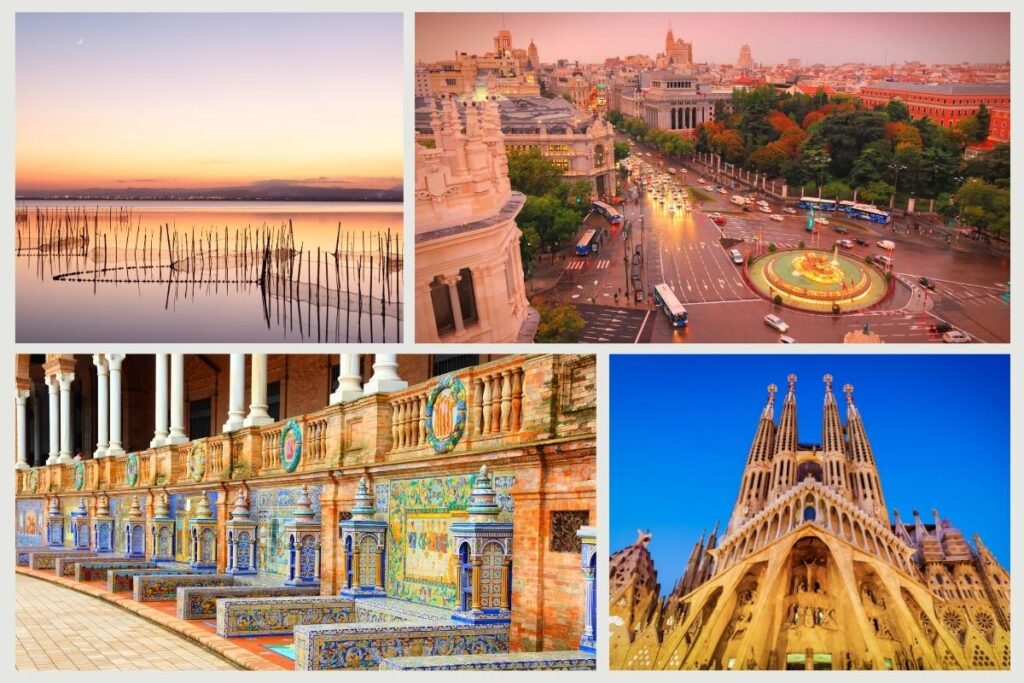
Barcelona is our home city, and it remains one of the two Spanish cities with the deepest venue and hotel inventory for corporate groups of any size. See our detailed look at corporate events in Barcelona and our case study on a 5-day annual meeting for 148 attendees for a sense of what we deliver here.
Community of Madrid
Spain’s capital suits business-first programmes with strong long-haul connectivity and large hotel capacity. Our guide to incentive travel in Madrid covers destination-specific detail for groups considering the city.
Andalusia
Seville and the wider Andalusian region bring historic venues and Moorish architecture. The pace is slower and more atmospheric, which suits gala dinners and cultural programmes particularly well. Granada and Cordoba offer a similar register for smaller groups. Both connect through Seville or Madrid rather than direct flights. Our guide to corporate events in Seville covers venues and logistics in the region.
Valencian Community
Valencia combines beach, old town, and modern architecture in a compact footprint. That makes it well suited to team building and mid-sized incentive groups. See our piece on corporate team building in Valencia for examples.
Balearic Islands
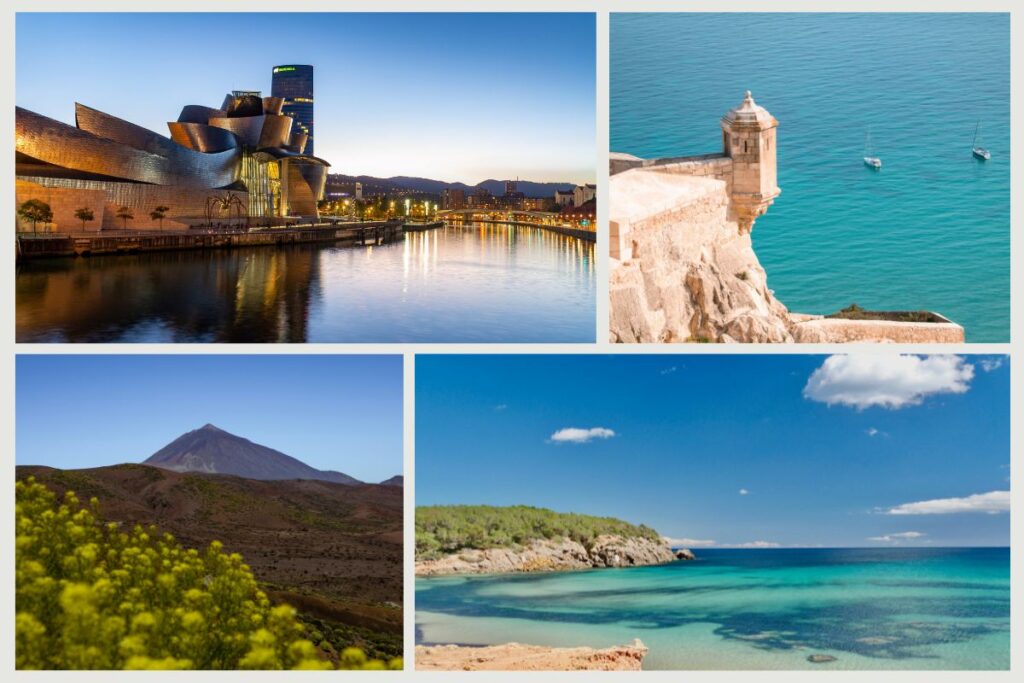
Mallorca and Ibiza offer island infrastructure without sacrificing meeting facilities. Modern conference space sits alongside coastal properties suited to smaller incentive groups. Closing dinners here get a very different backdrop to the mainland.
Basque Country
Bilbao and San Sebastian bring a different profile again. Strong gastronomy, compact city centres, and architecture-led venues such as the Guggenheim make for a distinctive gala setting. It is a smaller market than Madrid or Barcelona in hotel and venue volume. Lead time and date flexibility matter more here than in the bigger cities.
Canary Islands
The Canary Islands offer a year-round climate mainland Spain cannot match in winter. That makes them a strong option for incentive programmes and executive retreats outside the usual April-to-October season. Flight times from the mainland and from Northern Europe are short. The islands combine resort-level infrastructure with volcanic landscapes, giving programme designers something genuinely different to work with.
Costa del Sol
Malaga, Marbella, and the wider Costa del Sol combine a major airport with over 130 direct connections. Add dependable year-round sun and a stretch of coastline, and the region suits both incentive travel and relaxed executive meetings. Heavy investment in four and five-star hotels over the past decade has closed much of the gap with Barcelona and Madrid on venue quality.
Alicante Region
The Alicante region, on the Costa Blanca, brings a smaller-scale alternative to Valencia just up the coast. It has a compact city centre, reliable flight connections through Alicante-Elche airport, and a lower cost base. That suits mid-sized incentive groups and team building programmes that want beach access without the scale of Barcelona or Valencia. It also works well as a quieter extension for companies already running a Valencia programme.
Portugal, as a Natural Extension
A number of our clients run a single programme across both countries. Our DMC coverage extends into Portugal too, including team building in Porto and incentive travel in the Algarve. One point of contact manages both sides of the border, which removes the need to brief two separate local partners.
How to Vet a Destination Management Company in Spain
Not every company that calls itself a DMC in Spain has been through a formal accreditation process. It is worth checking a few things before you commit a budget and a date.
Membership of SpainDMCs, the official association of destination management companies in Spain, is a reasonable filter. To be accepted, a company must show a proven track record of at least three years organising MICE services in Spain. It also needs liability insurance of at least 350,000 euros, and recommendations from other members, clients, and suppliers.
Licensed travel agency status is a separate, legal requirement in Spain. Any company that packages transport, accommodation, and activities together needs a title-license from the tourism authority of its autonomous community. That licence is backed by a mandatory bond and civil liability insurance. A company with a public licence number, such as our own GC-1490, has been through that process rather than operating informally. MOGU’s guide to opening a travel agency in Spain sets out the requirements in full if you want the detail.
Beyond the paperwork, ask for references from events of a similar size and complexity to yours. Ask which region the team is actually based in, and how long the company has operated there. A DMC that has worked the same region for two decades solves problems differently to one that opened an office last year.
Destination Management Company vs Event Planner vs In-House Team
These three models get confused often enough that it is worth being precise. An event planner may work across several countries without a permanent local presence, coordinating on-the-ground suppliers remotely. An in-house team keeps full control, but has to build local relationships from scratch for every new destination. A destination management company sits between the two. It is based in the country and already holds the supplier relationships. It executes on the ground, while your team still owns the brief, the brand, and the budget approval.
Our guide to corporate event management in Spain looks at the in-house-versus-outsourced decision in more depth if you are still weighing that up.
What to Expect When You Hire a Destination Management Company in Spain
The shape of the engagement is fairly consistent across the industry, even if the detail varies by company.
Briefing and proposal. A first call to establish objectives, group size, dates, and budget range. Then a written proposal covering destination, venue options, and a draft itinerary, at no cost to you.
Planning and confirmation. Once the direction is agreed, contracts are signed. Every supplier negotiation happens on your behalf.
Onsite delivery. A bilingual team present throughout the event, managing logistics in real time rather than being reachable only by phone.
Post-event follow-up. Supplier invoices reconciled, feedback gathered, and a summary provided that supports internal reporting.
Throughout, you should have one named point of contact, not a different person for each supplier category. That single detail affects how quickly problems get resolved more than almost anything else in the relationship.
Budget Guidance for a Destination Management Company in Spain
Fees are usually structured as a flat management fee, a percentage of total supplier spend, or a day rate for onsite-only support. Our guide to corporate event management in Spain sets out how each model works and what tends to suit different event types. As a starting point, always ask directly which model a prospective DMC uses. Also ask whether supplier costs are passed through at cost or marked up, since that affects the real total more than the headline fee.
Why Companies Choose Crossover as Their Destination Management Company in Spain
Crossover has operated as a destination management company across Spain and Portugal since 2003. We are a licensed travel agency under registration GC-1490. We are also a Biosphere agency for sustainable event management, and a member of SpainDMCs. That means we have been through the association’s admission process, rather than simply using the term.
You can read more about how and why we joined the association in our SpainDMCs membership announcement, and see the people behind the work on our team page. We have delivered events for global companies including KPMG, IBM, and Nike, and our approach stays the same regardless of scale: understand the objective first, then build the logistics around it.
Frequently Asked Questions About a Destination Management Company in Spain
Is a destination management company the same as a travel agency? Legally, in Spain, yes. A DMC that packages transport, accommodation, and activities needs the same title-license as a traditional travel agency. In practice, a DMC specialises in corporate MICE work rather than leisure travel. The two are rarely interchangeable in terms of expertise.
Do I need a DMC based in the exact city I am visiting? Not necessarily, but you do want a DMC with an active presence and supplier relationships in that specific region, not just a national head office. Ask directly where the team delivering your event is based.
How much does a destination management company in Spain typically cost? It depends on the fee structure and the scope of the event. See our budget guidance in the corporate event management guide for typical ranges, or request a proposal for figures based on your own brief.
Can a DMC in Spain also manage an event in Portugal? Yes. Several agencies, including ours, operate across both countries through the same point of contact. That is useful for multi-country programmes.
How far in advance should I contact a DMC in Spain? Four to six months is usually enough for a single event under 100 people. Larger groups, multi-city programmes, or anything during peak season in Barcelona or Madrid are better started six to nine months out.
Getting Started
If you are comparing destination management companies in Spain, the clearest next step is a scoping conversation, not a generic quote. Tell us your destination, group size, and dates. We will put together a bespoke proposal that sets out exactly what we would manage on your behalf. Contact our team to start the conversation.
Contact our team to start the conversation.